


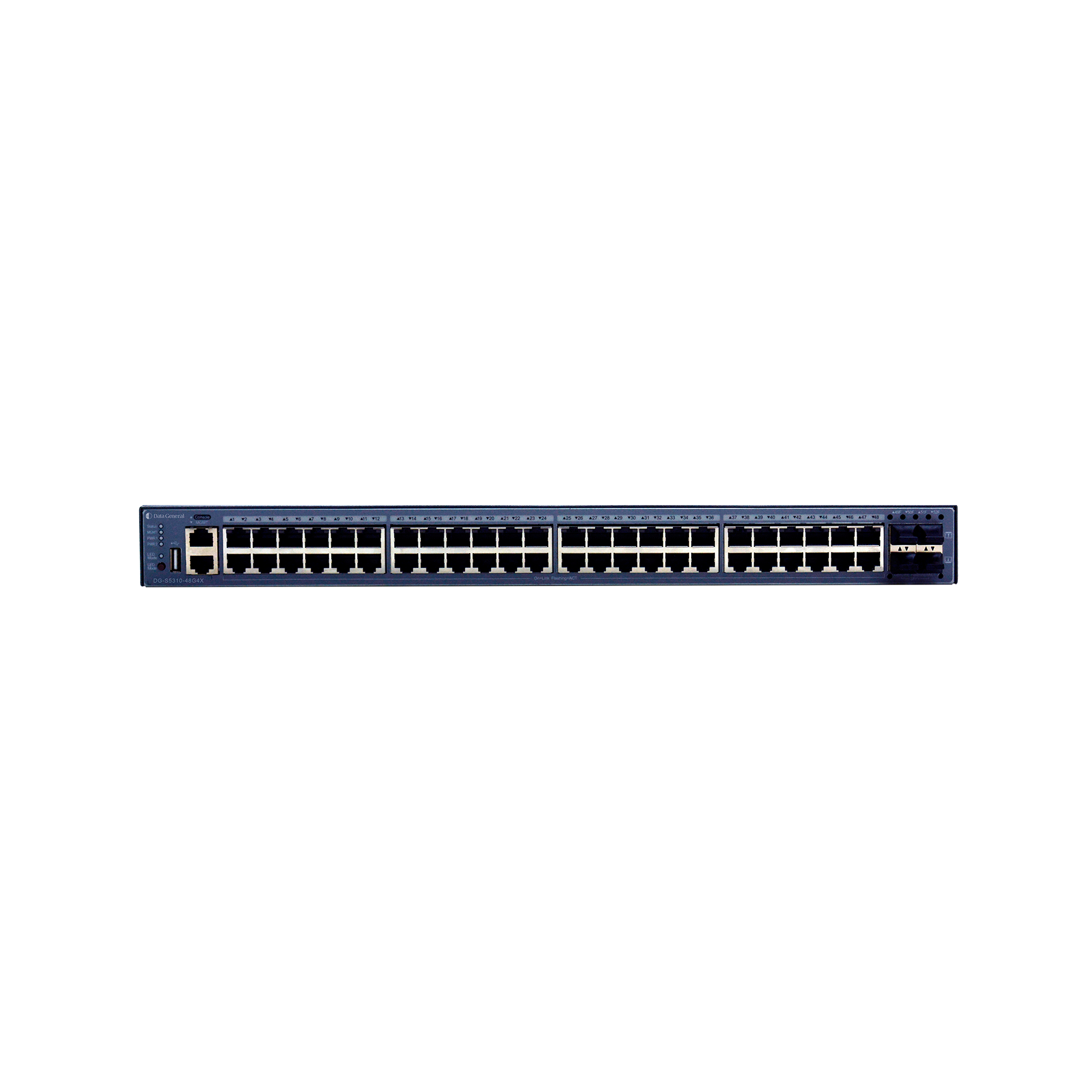
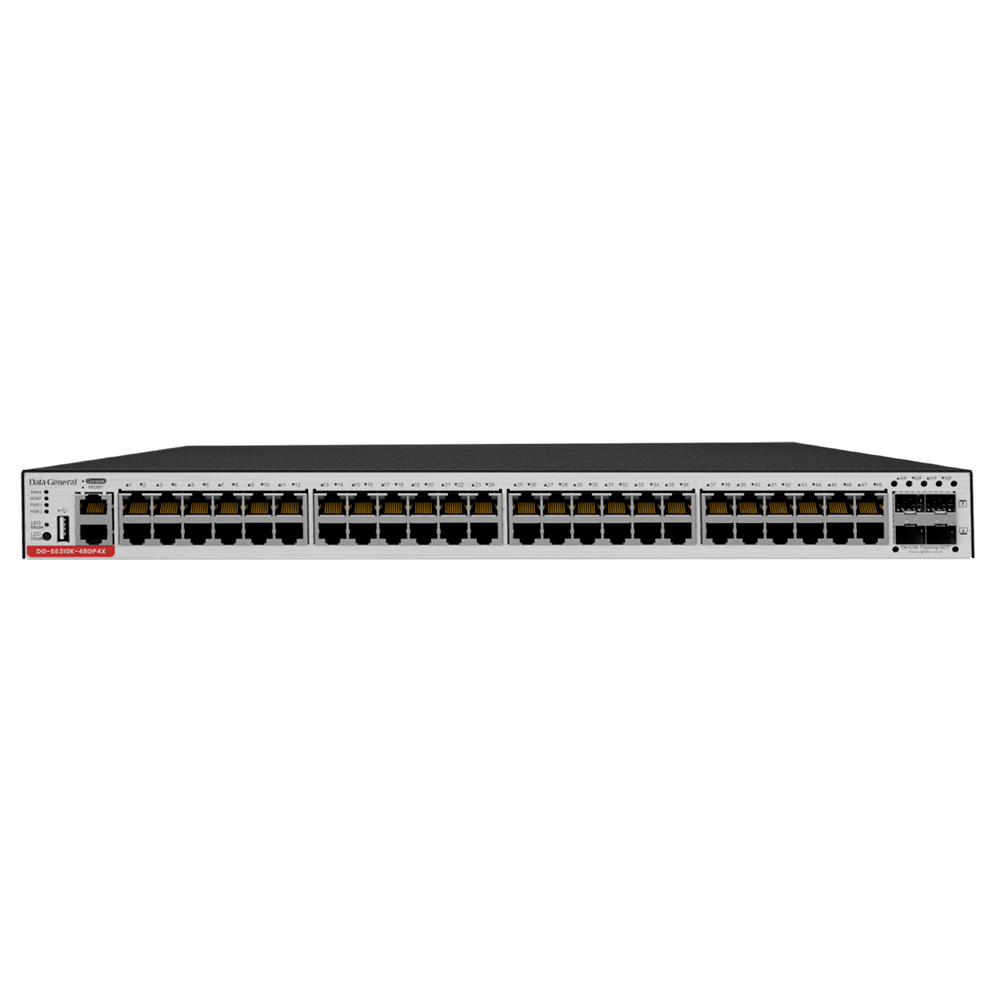
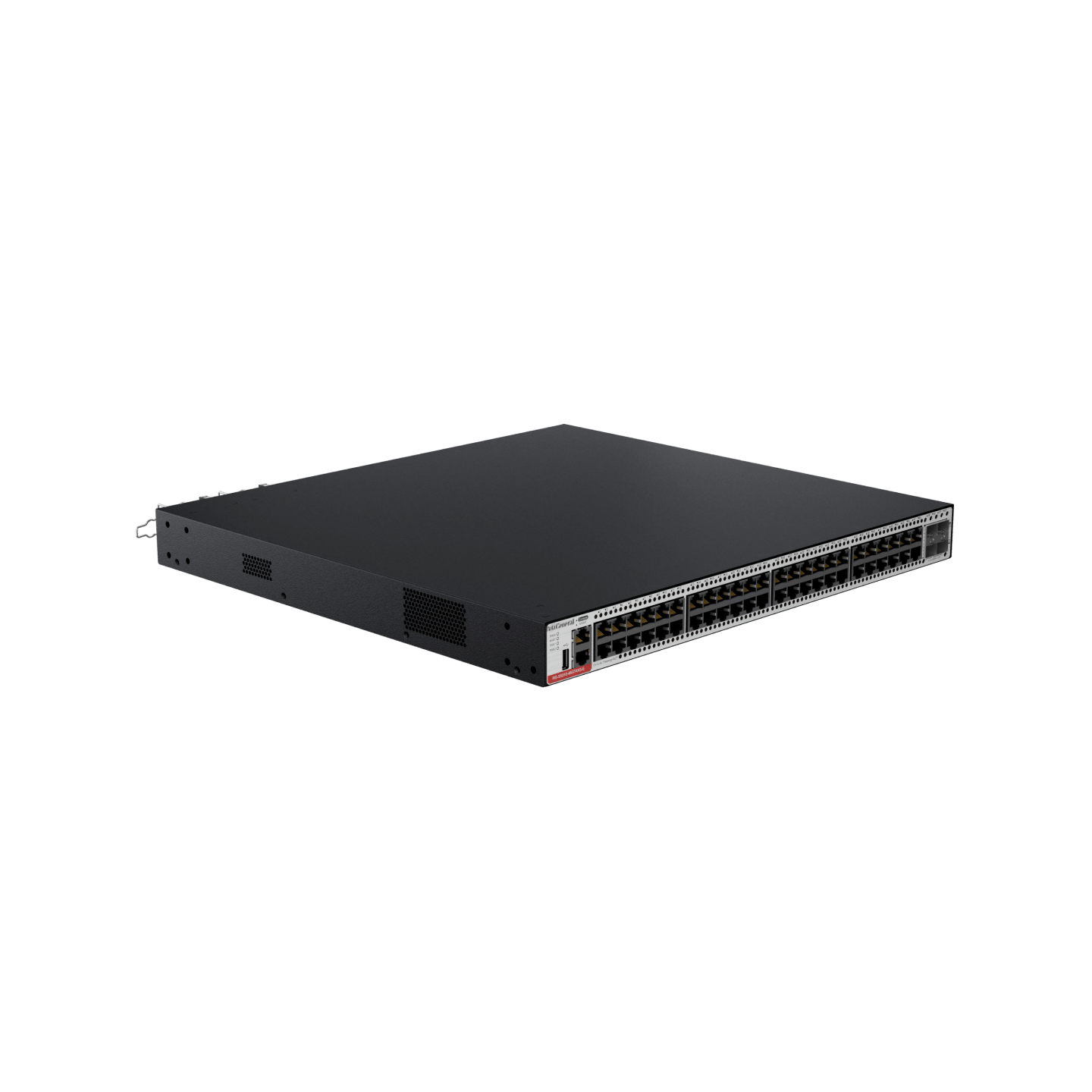
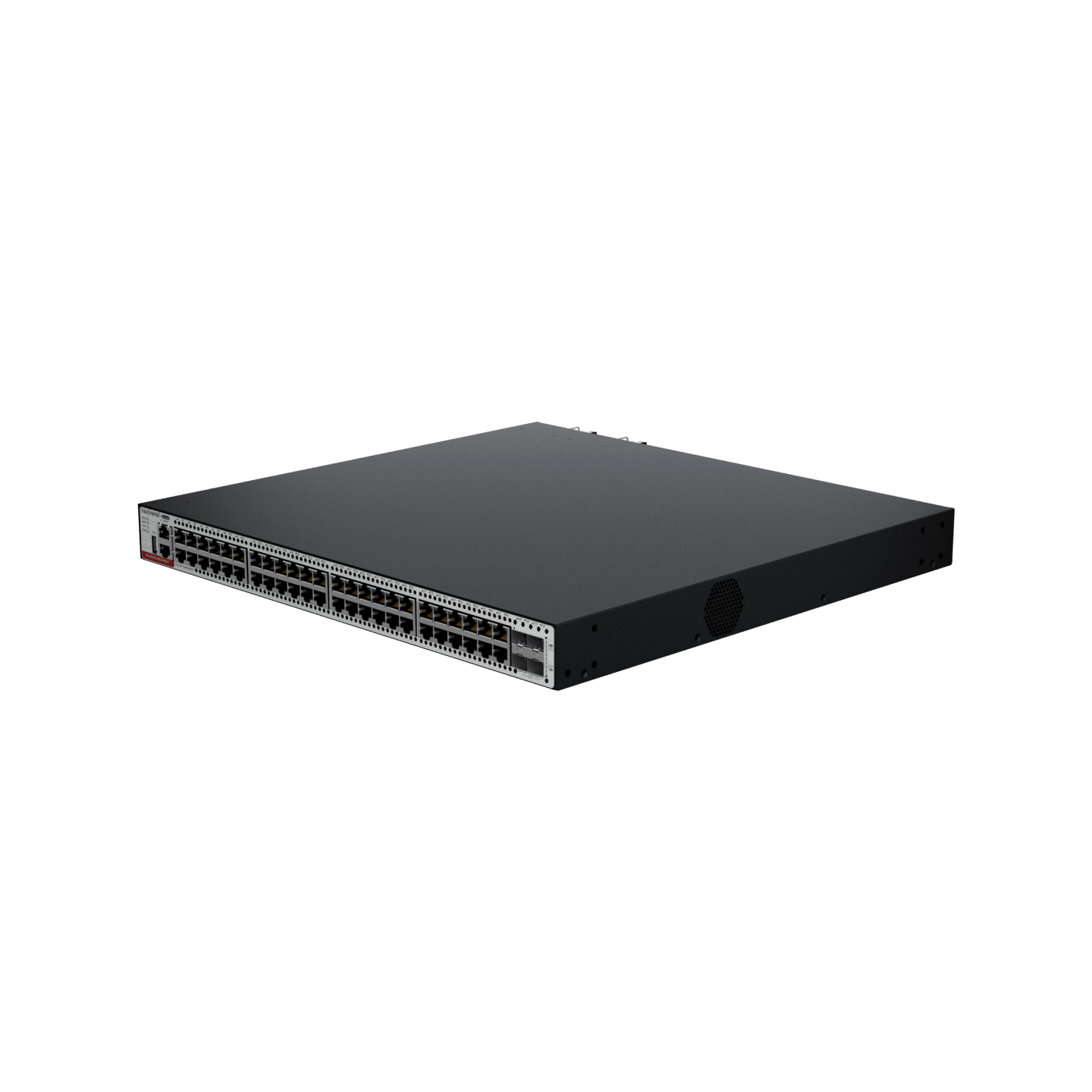
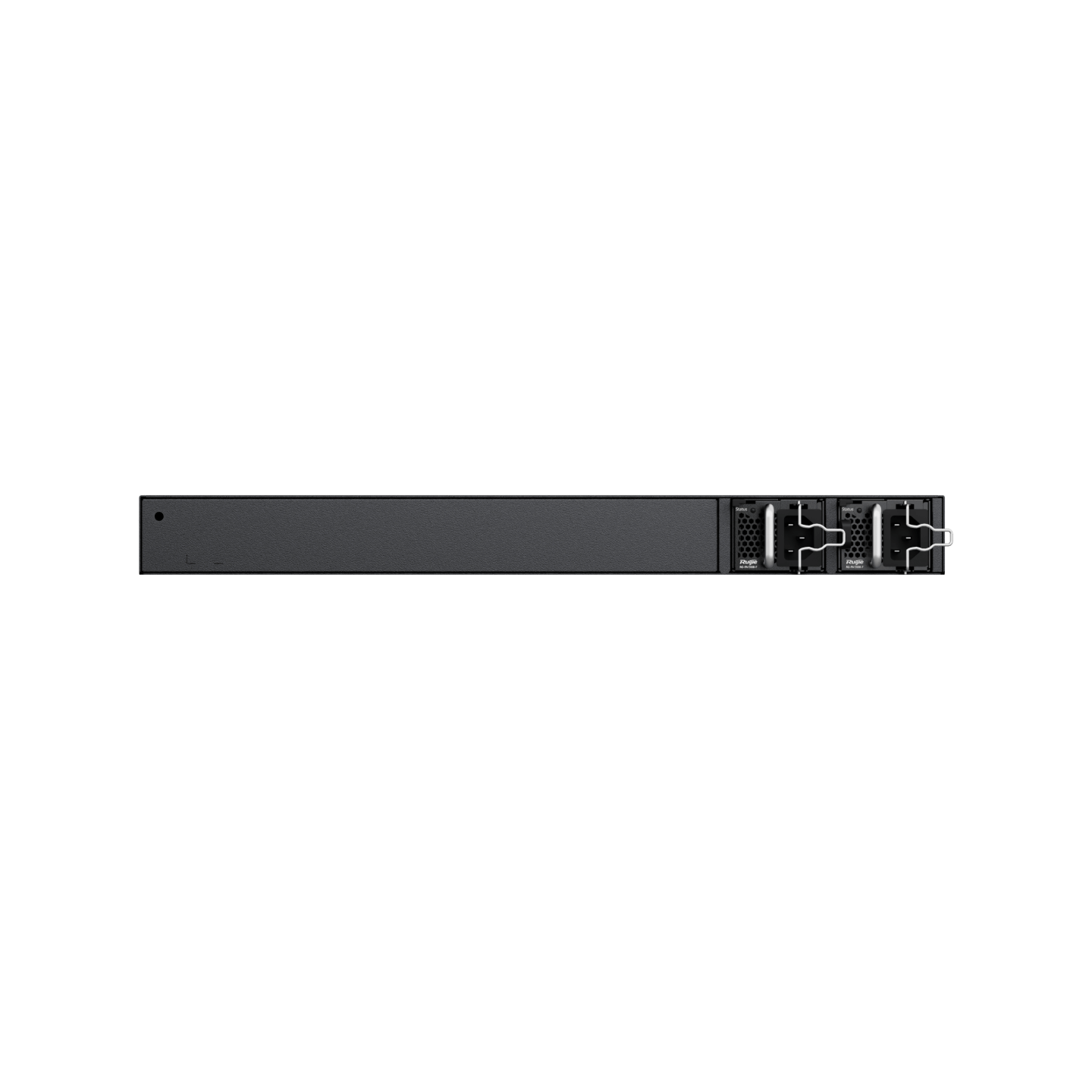
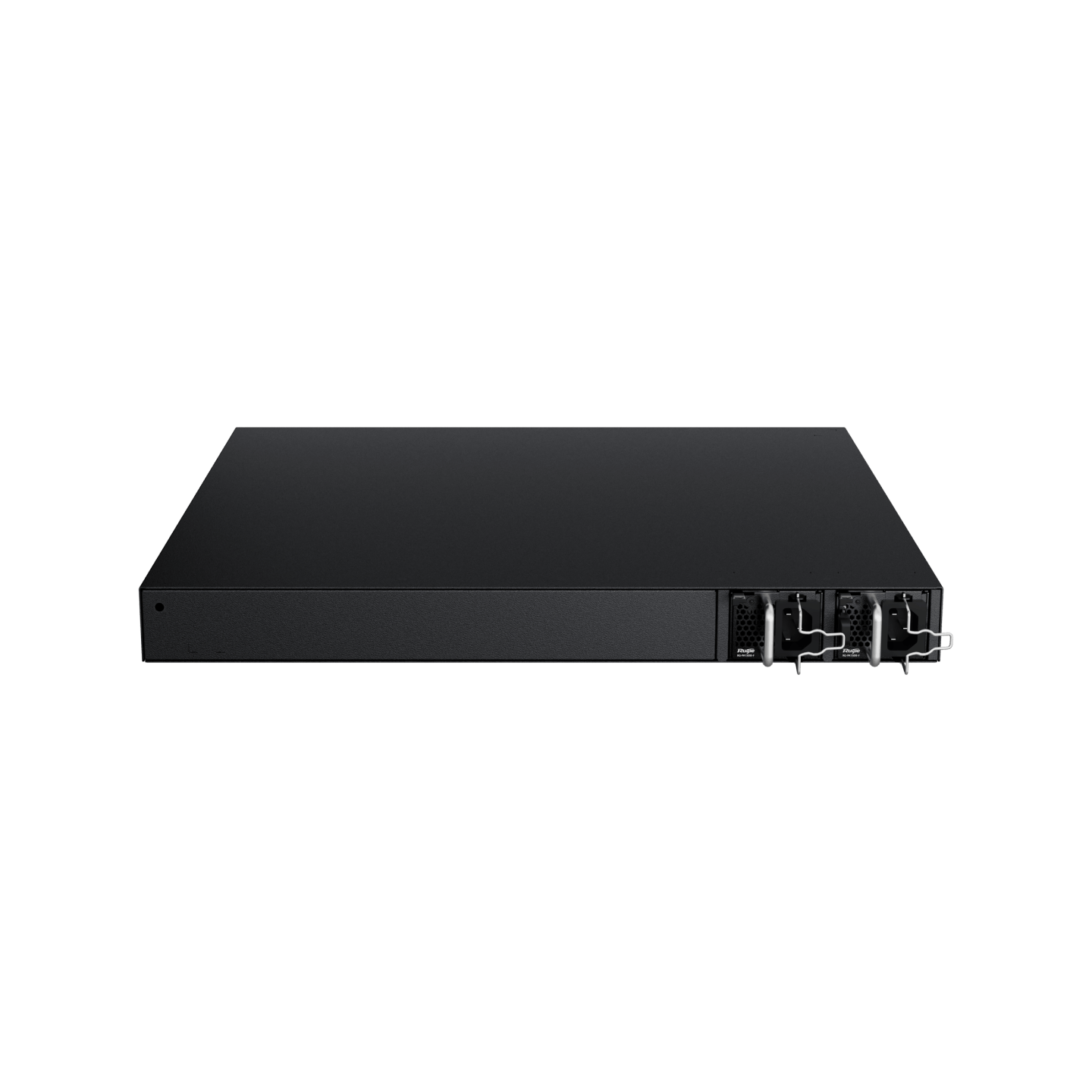
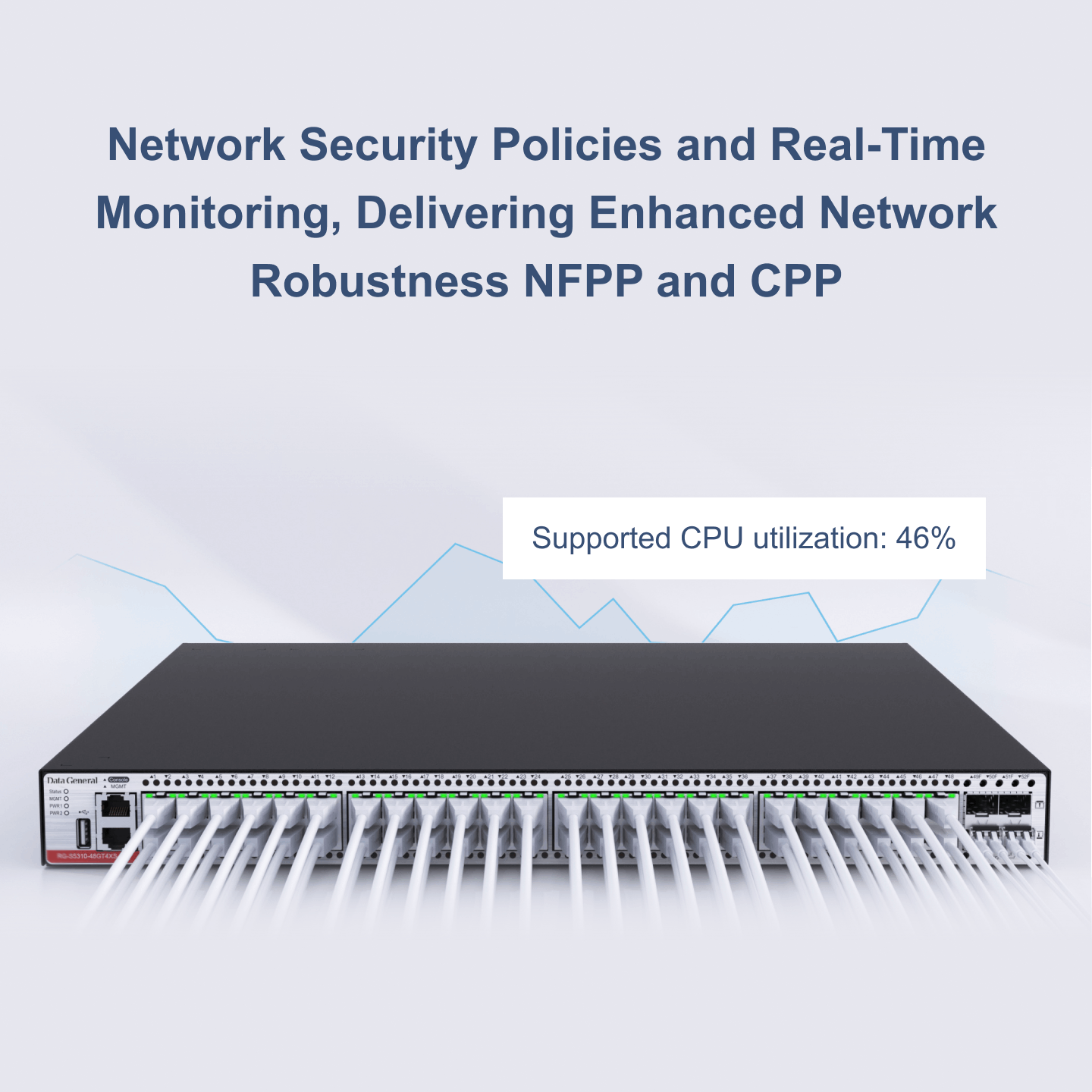
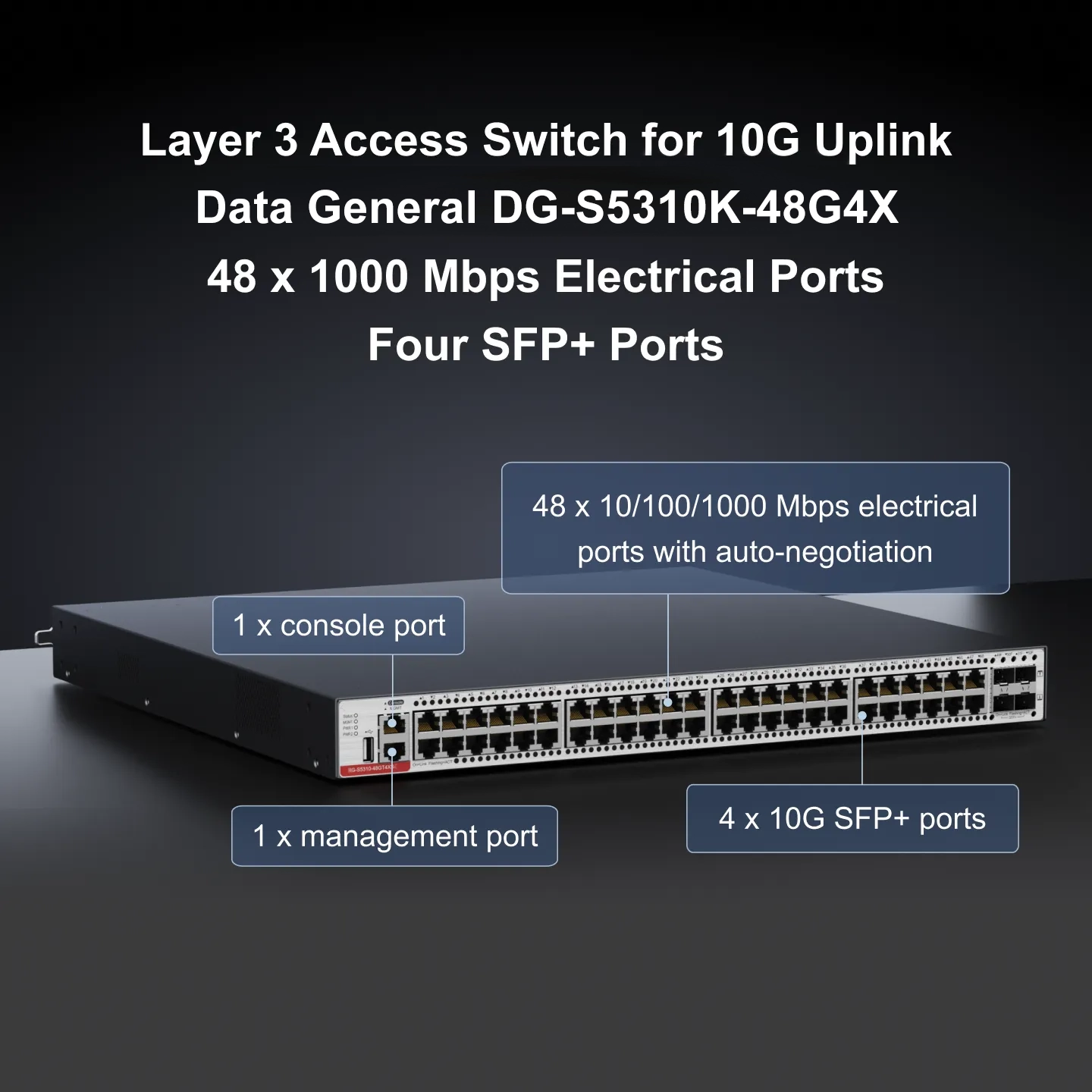
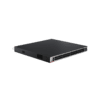
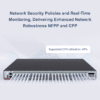
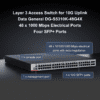

Layer 3 aggregation switch with 48 Gigabit Ethernet ports and 4 × 10G SFP+ uplinks. Ideal for enterprise backbones, campuses, hotels, and high-performance network infrastructures.
DG-S5310-48G4X Layer 3 Switch – High-Density Aggregation with 10G Uplinks
The DG-S5310-48G4X is a high-capacity Layer 3 Gigabit aggregation switch from Data General, designed for medium to large enterprise networks that require high port density, advanced routing capabilities, and ultra-fast uplinks. Equipped with 48 Gigabit Ethernet ports and 4 × 10G SFP+ uplink ports, it provides a powerful and scalable backbone for modern network infrastructures.
Built to operate at the aggregation or core layer, the DG-S5310K-48G4X efficiently consolidates traffic from multiple access switches, WiFi infrastructures, and edge devices. Its 10G SFP+ uplinks ensure high-throughput, low-latency connections to core switches, servers, or data centers, preventing bottlenecks in environments with heavy data and wireless traffic.
Thanks to its Layer 3 functionality, this switch supports advanced routing, VLAN segmentation, and traffic management directly at the switching layer. This improves overall network performance, enhances resilience, and simplifies network design by reducing dependence on external routing devices.
The DG-S5310K-48G4X is ideally suited for campuses, hotels, hospitals, corporate buildings, educational institutions, industrial networks, and large offices, where reliable aggregation, scalability, and performance are critical. Its high port count makes it especially attractive for projects with multiple access switches and structured cabling layouts.
By combining 48 Gigabit ports, advanced Layer 3 features, and high-speed 10G uplinks, the DG-S5310K-48G4X delivers a robust, future-ready aggregation switch for professional and enterprise-grade networks.
Hardware Specifications |
DG-S5310-48G4X |
|---|---|
Interface Specifications |
|
| Fixed port | 48 x 10/100/1000 BASE-T ports |
| 4 x 1G/10G SFP+ ports | |
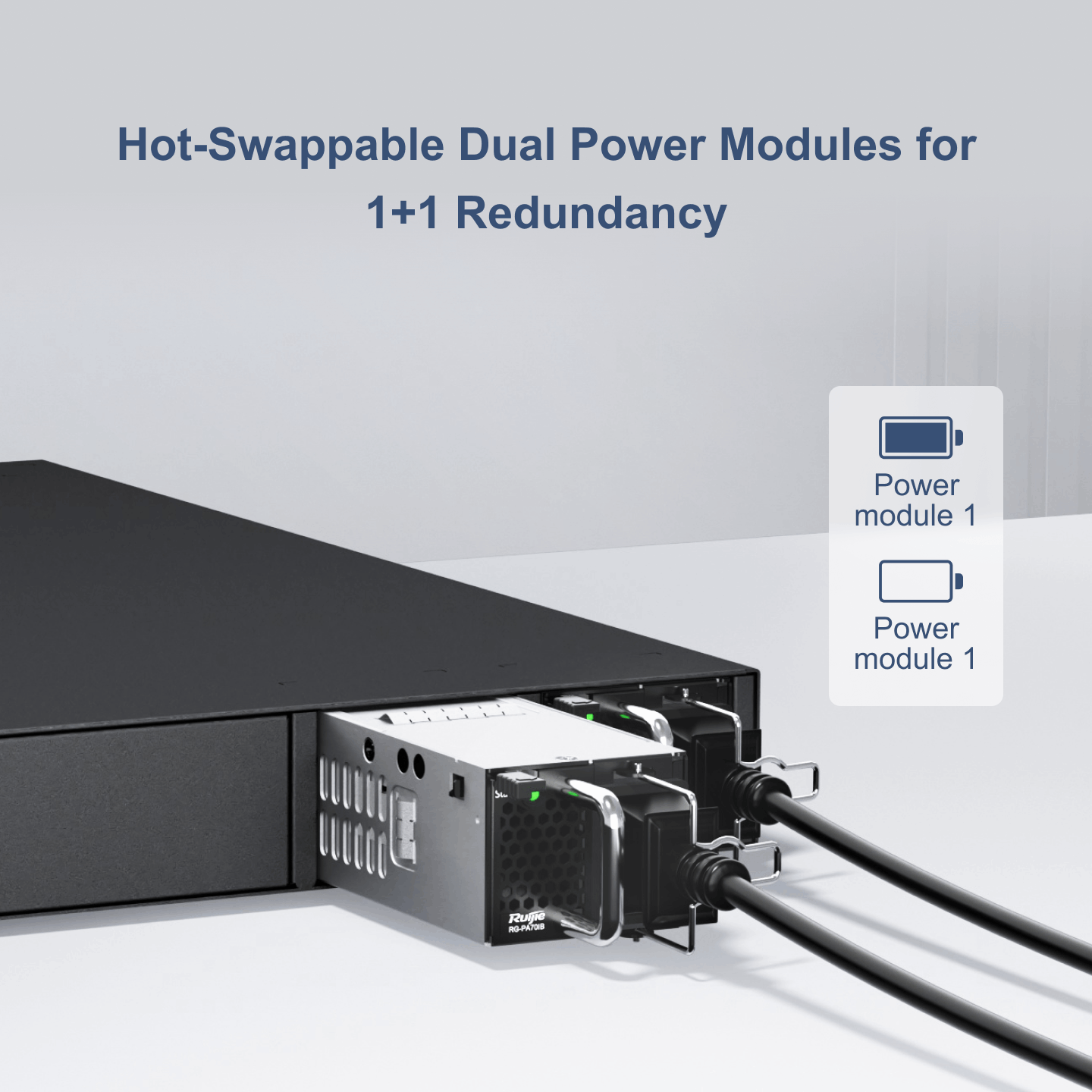
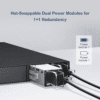
| Power module | 2 x power modules (1+1 redundancy of power modules) |
| Management port | |
System Specifications |
|
| Switching Capacity | 176 Gbps |
| Packet Forwarding Rate | 131 Mpps |
| Number of MAC addresses | 32 |
| ARP table size | 4k/16k (authorized) |
| ND table size | 2k/8k (authorized) |
| Number of IPv4 unicast routes | 8k/12k (authorized) |
| Number of IPv4 multicast routes | 2.5 |
| Number of IPv6 unicast routes | 4 |
| Number of IPv6 multicast routes | 1.2 |
| Number of ACEs | Ingress: 3,500 |
| Egress: 1,500 | |
| Number of IGMP groups | 2.5 |
| Number of MLD groups | 1 |
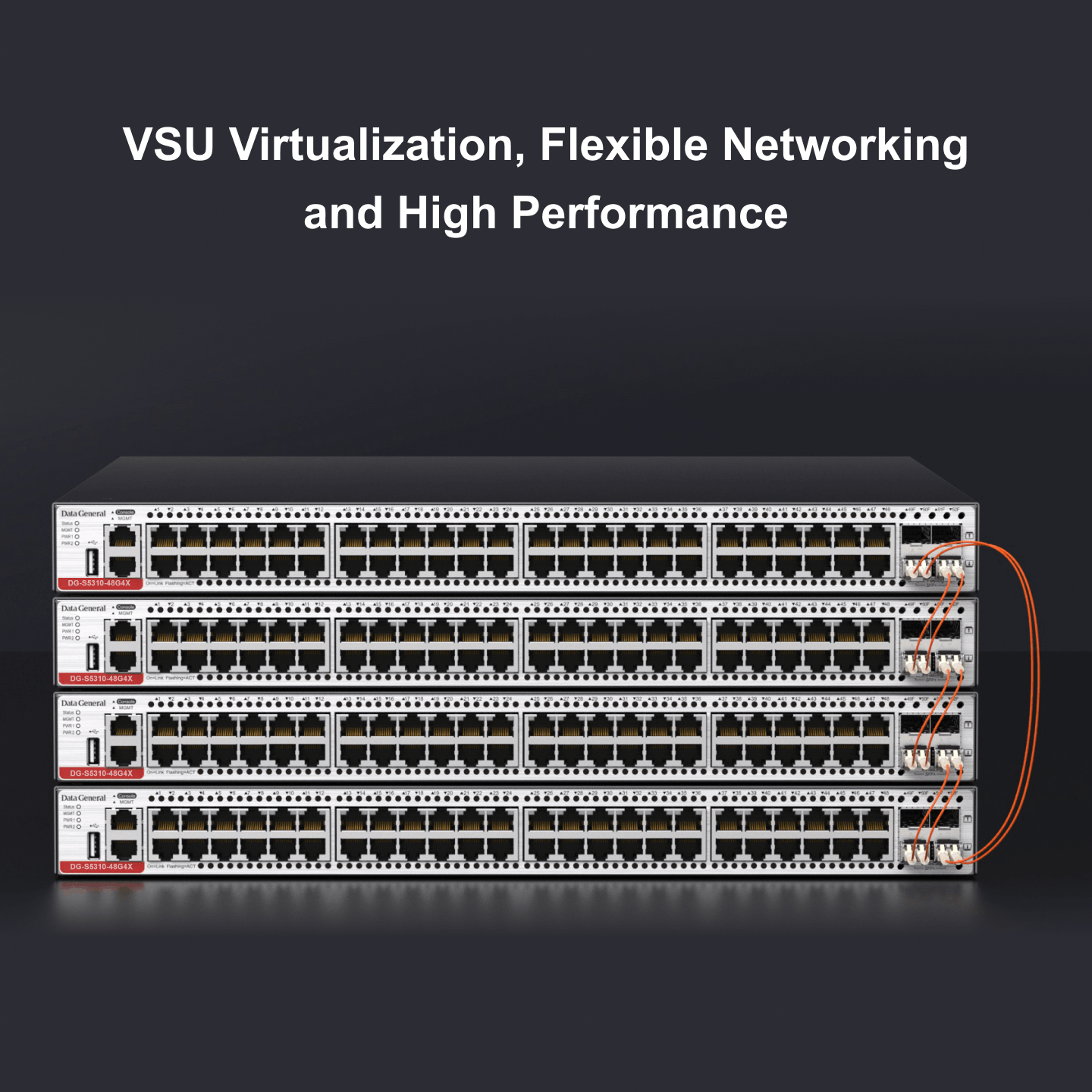
| Number of VSU members | 4 |
Dimensions and Weight |
|
| Dimensions (W x D x H) | 442 mm x 420 mm x 43.6 mm (17.40 in. x 16.56 in. x 1.72 in.), 1 RU |
| Weight | 4.3 kg (9.48 lbs) |
CPU and Storage |
|
| CPU | 1.2 GHz dual-core processor |
| BOOTROM | 16 MB |
| Flash | 2 GB |
| SDRAM | 1 GB |
Power and Consumption |
|
| Maximum power consumption | ≤ 55 W |
| Maximum output power | DG-PA70IB: 70 W |
| DG-PA150IB-F: 150 W | |
| DG-PD150IB-F: 150 W | |
| Rated input voltage | DG-PA70IB: 100 V AC to 240 V AC |
| DG-PA150IB-F: 100 V AC to 240 V AC | |
| DG-PD150IB-F: -48 V DC to -60 V DC | |
| Maximum input voltage | DG-PA70IB: 90 V AC to 264 V AC, 50 Hz to 60 Hz |
| DG-PA150IB-F: 90 V AC to 264 V AC, 50 Hz to 60 Hz | |
| DG-PD150IB-F: -36 V DC to -75 V DC | |
Environment and Reliability |
|
| MTBF | 40.03 years (dual power modules) |
| 23.53 years (single power module) | |
| Primary airflow | Left/Front-to-rear airflow |
| Operating temperature | 0°C to 45°C (32°F to 113°F) |
| Storage temperature | –40°C to +70°C (–40°F to +158°F) |
| Operating humidity | 10% to 90% RH (non-condensing) |
| Storage humidity | 5% to 95% RH (non-condensing) |
| Operating altitude | 0 m to 5000 m (16404.20 ft.) |
| Operating noise | < 52.4 dB |
| Interface suDGe protection | Power port: 6 kV |
| Telecom port: 10 kV (MGMT port: 4 kV) | |
Software Specifications |
|
DG-S5310-E Series |
|
Feature |
|
| Ethernet Switching | IEEE 802.1Q (supporting 4K VLANs) |
| Jumbo frame (maximum length: 9,216 bytes) | |
| Maximum number of VLANs that can be created: 4,094 | |
| Voice VLAN | |
| Super VLAN and private VLAN | |
| MAC address-based, port-based, protocol-based, and IP subnet-based VLAN assignment | |
| GVRP | |
| Basic QinQ and selective QinQ | |
| STP (IEEE 802.1.d), RSTP (IEEE 802.1w), and MSTP (IEEE 802.1s) | |
| Auto errdisable recovery | |
| BPDU filter | |
| BPDU guard | |
| Port fast | |
| Root guard | |
| ERPS (G.8032) | |
| LLDP/LLDP-MED, LLDP IPv6, and LLDP-POE | |
| IP Service | Static and dynamic ARP, ARP proxy, and ARP entry timeout |
| DHCP client, DHCP relay, DHCP server, and DHCP snooping | |
| DHCPv6 client, DHCPv6 relay, DHCPv6 server, and DHCPv6 snooping | |
| DNS client, DNS proxy, and DNSv6 client | |
| MAC address filtering | |
| Setting the MAC address aging time | |
| Neighbor Discovery (ND), ND proxy, and ND snooping | |
| GRE tunnel | |
| IP Routing | IPv4 and IPv6 static routing |
| RIP and RIPng | |
| OSPFv2, OSPFv3, and GR | |
| IS-ISv4 and IS-ISv6 | |
| BGP4 and BGP4+ | |
| IPv4/IPv6 VRF | |
| IPv4/IPv6 PBR | |
| Multicast | IGMPv1/v2/v3 |
| IGMPv1/v2 snooping | |
| IGMP fast leave | |
| PIM-DM, PIM-SM, PIM-SSM, PIM SMv6, and PIM-SSMv6 | |
| MSDP for inter-domain multicast | |
| MLDv1/v2 and MLD proxy | |
| MLDv1/v2 snooping | |
| PIM-SMv6 | |
| Multicast source IP address check | |
| Multicast source port check | |
| Multicast querier | |
| ACL and QoS | Standard IP ACLs (hardware ACLs based on IP addresses) |
| Extended IP ACLs (hardware ACLs based on IP addresses or TCP/UDP port numbers) | |
| Extended MAC ACLs (hardware ACLs based on source MAC addresses, destination MAC addresses, and optional Ethernet type) | |
| Expert-level ACLs (hardware ACLs based on flexible combinations of the VLAN ID, Ethernet type, MAC address, IP address, TCP/UDP port number, protocol type, and time range) | |
| Time based ACLS, ACL 80, and IPv6 ACL | |
| Global ACLs | |
| ACL redirection | |
| Port traffic identification | |
| Port traffic rate limiting | |
| 802.1p/DSCP/ToS traffic classification | |
| Congestion management: SP, WRR, DRR, WFQ, SP+WFQ, SP+WRR, SP+DRR, and SP+WFQ | |
| Congestion avoidance: tail drop, RED, and WRED | |
| Eight priority queues per port | |
| Rate limiting in each queue | |
| Security | Multiple AAA modes |
| RADIUS authentication and authorization | |
| RADIUS and TACACS+ | |
| IEEE802.1X authentication, MAC address bypass (MAB) authentication, and interface-based and MAC address-based 802.1X authentication | |
| Web authentication | |
| Hypertext Transfer Protocol Secure (HTTPS) | |
| SSHv1 and SSHv2 | |
| Global IP-MAC binding | |
| ICMPv6 | |
| Port security | |
| IP source guard | |
| SAVI | |
| ARP spoofing prevention | |
| CPP and NFPP | |
| Multiple attack defense functions | |
| 3-tuple binding (IP address, MAC address, and port) | |
| 3-tuple binding (IPv6 address, MAC address, and port) | |
| Filtering of invalid MAC addresses | |
| Port- and MAC address-based 802.1x authentication | |
| MAB authentication | |
| Portal authentication and Portal 2.0 authentication | |
| ARP check | |
| DAI | |
| ARP packet rate limiting | |
| Gateway ARP spoofing prevention | |
| Broadcast storm suppression | |
| Hierarchical management of administrators and password protection | |
| BPDU guard | |
| Port protection | |
| Reliability | REUP |
| RLDP | |
| RLDP, Layer 2 link connectivity detection, and unidirectional link detection | |
| DLDP | |
| IPv4 VRRP v2/v3, IPv6 VRRP, and super-VLAN for VRRP | |
| BFD, RAS, NSR, VRRR, VRRP+, and SDN loop detection | |
| Basic LACP | |
| Inter-VSU AP | |
| Link monitoring, fault notification, and remote loopback based on 802.3ah (EFM) | |
| Hot swapping of power modules | |
| Device virtualization | VSU |
| Local and remote stacking | |
| Inter-chassis link binding in a stack | |
| Virtualization through standard service interfaces | |
| NMS and maintenance | RSPAN and ERSPAN |
| sFlow | |
| NTP client, NTP server, NTPv6 client, and NTPv6 server | |
| SNTP | |
| CLI (Telnet/Console) | |
| FTP client, FTP server, FTPv6 client, and FTPv6 server | |
| TFTP client, TFTP server, TFTPv6 client, and TFTPv6 server | |
| FTP and TFTP | |
| SNMP v1/v2/c3 | |
| Web | |
| Syslog/Debug | |
| RMON (1, 2, 3, 9) | |
| Various types of RMON groups, including event groups, alarm groups, history groups, and statistics groups, as well as private alarm extension groups | |
| RMON used to implement Ethernet statistics, historical statistics, and alarm functions | |
| NETCONF | |
| MACC | |
| CWMP | |
| gRPC | |
| OpenFlow Special 1.3 | |
| Flow table analysis defined by all protocols | |
| Transmission of specified packets to the controller | |
| Configuring the controller’s IP address and port | |
| Notifying port status changes to the controller | |
| RNS, configuration rollback, and 802.3ah | |
| 1:1 mirroring | |
| N:1 mirroring | |
| 1:N mirroring | |
| Flow-based local and remote mirroring | |
| VXLAN | VXLAN (authorized) |
| PoE | DG-S5310-24GP4X and DG-S5310-48GP4X: |
| IEEE 802.3af and 802.3at power supply standards | |
| Automatic and eneDGy-saving power supply management modes | |
| Uninterrupted power supply in hot start mode | |
| Scheduled power-on or power-off of PoE ports based on the time policy | |
| Port priority |
FIRMWARE
DATASHEETS

Secure connectivity for professional environments.
© 2026 Data General LLC. All rights reserved.
