
10 GB Switch with 24 PoE+ and 4 SFP+ ports
DG-S5300K-24GP4X-370W

Key points
- 10 GB PoE+ Switch
- 128 Gbps Capacity
- 24 Gigabit ports
- 4 SFP+ 10G ports
- 24 802.3at PoE+ ports
- 370W PoE power
- L3 Managed Switch
- Openflow SDN compatible
Compact Power and Speed
The Data General DG-S5300K-24GP4XS-370W is a 10 GB Layer 3 manageable access switch with a 128 Gbps switching capacity. It features 24 gigabit PoE+ ports, delivering 370W of power, along with 4 SFP+ 10 Gbps ports.
These robust capabilities make it an ideal choice for installations that require access switches to connect different areas to an aggregation switch or a 10 Gbps core switch, while simultaneously powering and connecting devices like access points, cameras, and IP phones.
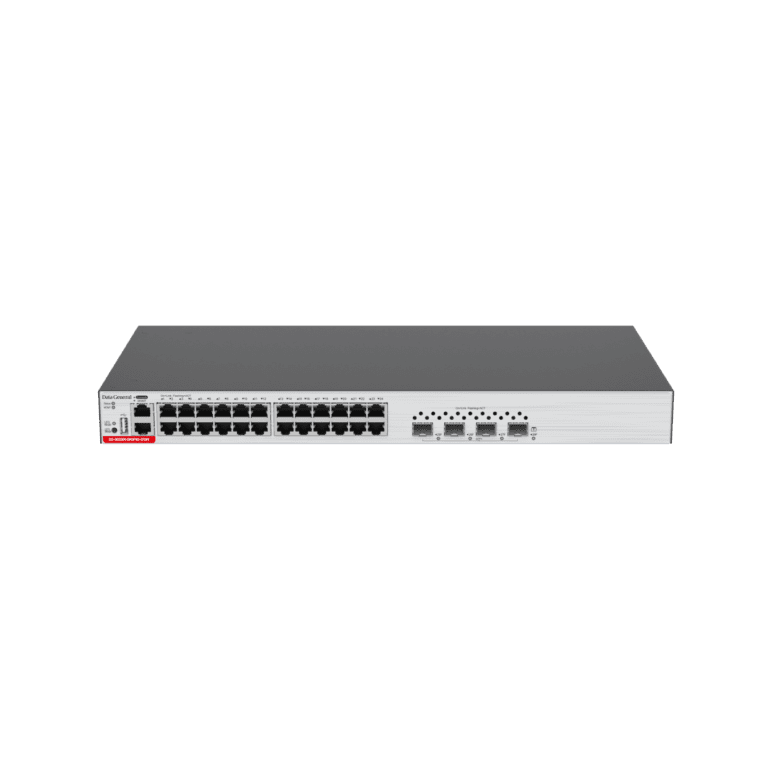
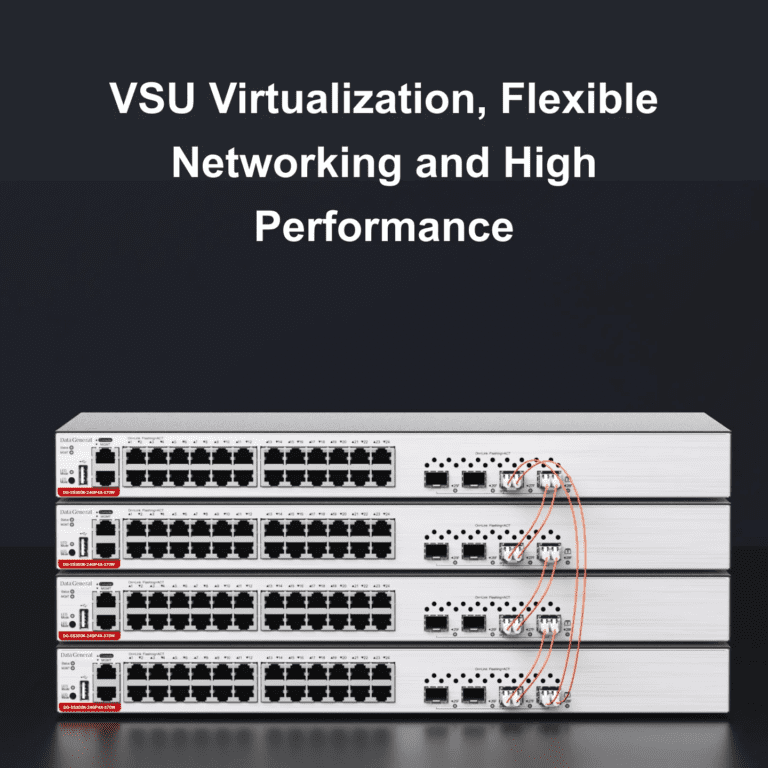
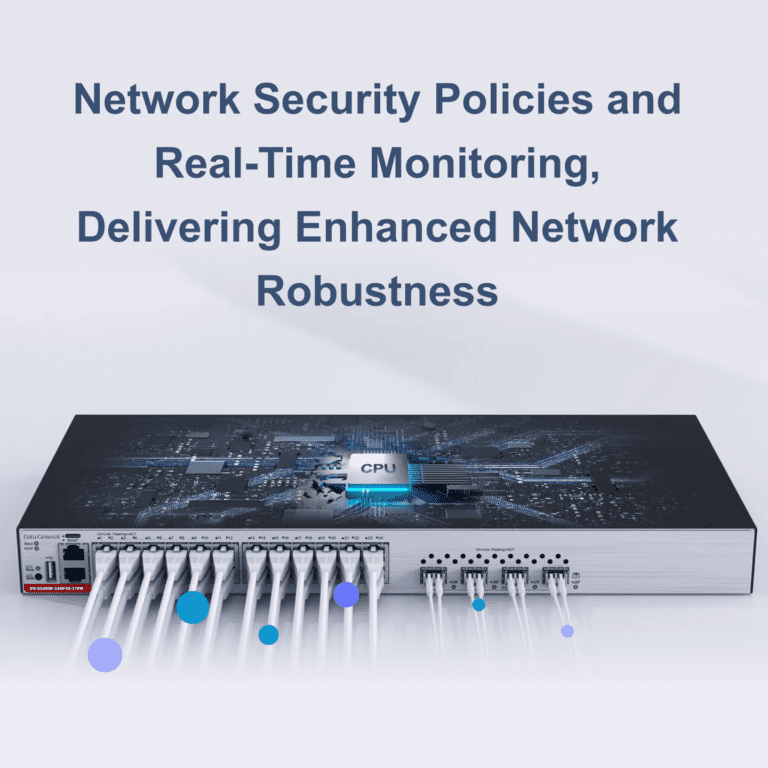

- 10 GB PoE+ Switch.
- High-capacity PoE+ compliant ports, 24 1 Gbps Ethernet ports.
- 4 10G optical uplink ports.
- VSU virtualization, flexible networks and high performance
Network security policies and real-time monitoring, providing network robustness. - Abundant QoS policies for flexible resource allocation, eliminating possible congestion.
- Intelligent speed regulation, automatic port suspension, energy saving.
- Multiple management modes, simplified and easy network maintenance.
| Hardware Specifications | DG-S5300K-24GP4XS-370W | |
|---|---|---|
| Interface Specifications | ||
| Fixed port | 24 x 10/100/1000M auto-negotiation electrical ports, 4 x 1G/10G SFP+ ports | |
| Power module | Built-in power module | |
| Fixed management port | 1 x MGMT port, 1 x console port, and 1 x USB port | |
| System Specifications | ||
| Packet forwarding rate | 96 Mpps/126 Mpps | |
| System switching capacity | 336 Gbps/3.36 Tbps | |
| Number of MAC addresses | 32 | |
| ARP table size | 2 | |
| ND table size | 1 | |
| Number of IPv4 unicast routes | 4 | |
| Number of IPv4 multicast routes | 2.5 | |
| Number of IPv6 unicast routes | 2 | |
| Number of IPv6 multicast routes | 1.2 | |
| Number of ACEs | Ingress: 3,500 | |
| Egress: 1,500 | ||
| Number of VSU members | 4 | |
| Number of IGMP groups | 2.5 | |
| Number of MLD groups | 1 | |
| Number of VRFs | 512 | |
| Dimensions and Weight | ||
| Dimensions (W x D x H) | 442 mm x 220 mm x 43.6 mm (17.40 in. x 8.66 in. x 1.72 in.), 1 RU | |
| Weight (full load) | 3 kg (6.61 lbs) | |
| CPU and Storage | ||
| CPU | 1.2 GHz dual-core processor | |
| Storage | Flash memory: 2 GB | |
| SDRAM: 1 GB | ||
| Power and Consumption | ||
| Maximum power consumption | System power consumption (without PoE load) < 65 W | |
| System power consumption (with PoE load) < 410 W | ||
| Rated input voltage | AC input: 100 V to 240 V | |
| Frequency: 50/60 Hz | ||
| Maximum input voltage | AC input: 90 V to 264 V | |
| Environment and Reliability | ||
| MTBF | > 200,000 hours | |
| Primary airflow | Front-to-rear airflow | |
| Operating temperature | 0°C to 45°C (32°F to 113°F) at an altitude in the range of 0 m to 1,800 m (5905.51 ft.) | |
| Altitude 1,800 m (5905.51 ft.) to 5,000 m (16404.20 ft.): The maximum temperature decreases by 1°C (1.8°F) each time the altitude increases by 220 m (721.78 ft.). | ||
| Storage temperature | –40°C to +70°C (–40°F to +158°F) | |
| Operating humidity | 10% to 90% RH (non-condensing) | |
| Storage humidity | 5% to 90% RH (non-condensing) | |
| Operating altitude | 0 m to 5,000 m (16404.20 ft.) | |
| Operating noise | 33.5 dB at the temperature of 27°C (80.6°F) | |
| 53.9 dB at the temperature of 45°C (113°F) | ||
| Interface surge protection | Communication port: 10 kV (common mode) (MGMT port: 4 kV) | |
| Power port: 6 kV (common/differential mode) | ||
| Software Specifications | ||
| RG-S5300-E Series | ||
| Feature | Description | |
| Ethernet switching | IEEE 802.1Q (supporting 4K VLANs) | |
| Jumbo frame (maximum length: 9,216 bytes) | ||
| Maximum number of VLANs that can be created: 4,094 | ||
| Voice VLAN | ||
| Super VLAN and private VLAN | ||
| MAC address-based, port-based, protocol-based, and IP subnet-based VLAN assignment | ||
| GVRP | ||
| Basic QinQ and selective QinQ | ||
| STP (IEEE 802.1.d), RSTP (IEEE 802.1w), and MSTP (IEEE 802.1s) | ||
| Auto errdisable recovery | ||
| BPDU filter | ||
| BPDU guard | ||
| Port fast | ||
| Root guard | ||
| ERPS (G.8032 v1/v2), sing ring, tangent ring, intersecting ring and load balancing | ||
| LLDP/LLDP-MED, LLDP IPv6, and LLDP-POE | ||
| MAC address filtering | ||
| Setting the MAC address aging time | ||
| IP service | Static and dynamic ARP, ARP proxy, and ARP entry timeout | |
| DHCP client, DHCP relay, DHCP server, and DHCP snooping | ||
| DHCPv6 client, DHCPv6 relay, and DHCPv6 snooping | ||
| DNS client, DNS proxy, and DNSv6 client | ||
| Neighbor Discovery (ND), ND proxy, and ND snooping | ||
| IPv6 addressing, IPv6 ping, and IPv6 tracert | ||
| GRE tunnel | ||
| IP routing | IPv4 and IPv6 static routing | |
| RIP and RIPng | ||
| OSPFv2 and OSPFv3 | ||
| IS-ISv4 and IS-ISv6 | ||
| BGP4 and BGP4+ | ||
| Routing policy | ||
| IPv4/VRF | ||
| IPv4/IPv6 PBR | ||
| Multicast | IGMPv1/v2/v3 | |
| IGMPv1/v2 snooping | ||
| IGMP fast leave | ||
| PIM-DM, PIM-SM, PIM-SSM, PIM SMv6, and PIM-SSMv6 | ||
| MSDP for inter-domain multicast | ||
| MLDv1/v2 and MLD proxy | ||
| MLDv1/v2 snooping | ||
| PIM-SMv6 | ||
| Multicast source IP address check | ||
| Multicast source port check | ||
| ACL and QoS | Standard IP ACLs (hardware ACLs based on IP addresses) | |
| Extended IP ACLs (hardware ACLs based on IP addresses or TCP/UDP port numbers) | ||
| Extended MAC ACLs (hardware ACLs based on source MAC addresses, destination MAC addresses, and optional Ethernet type) | ||
| Expert-level ACLs (hardware ACLs based on flexible combinations of the VLAN ID, Ethernet type, MAC address, IP address, TCP/UDP port number, protocol type, and time range) | ||
| Time based ACLs, ACL 80, and IPv6 ACL | ||
| Global ACLs | ||
| ACL redirection | ||
| Port traffic identification | ||
| Port traffic rate limiting | ||
| 802.1p/DSCP/ToS traffic classification | ||
| Congestion management: SP, WRR, DRR, WFQ, SP+WFQ, SP+WRR, SP+DRR, and SP+WFQ | ||
| Congestion avoidance: tail drop, RED, and WRED | ||
| Eight priority queues per port | ||
| Security | Multiple AAA modes | |
| RADIUS | ||
| RADIUS and TACACS+ | ||
| IEEE802.1X authentication, MAC address bypass (MAB) authentication, and interface-based and MAC address-based 802.1X authentication | ||
| Web authentication | ||
| Hypertext Transfer Protocol Secure (HTTPS) | ||
| SSHv1 and SSHv2 | ||
| Global IP-MAC binding | ||
| ICMP | ||
| Port security | ||
| IP source guard | ||
| SAVI | ||
| ARP spoofing prevention | ||
| CPP and NFPP | ||
| Multiple attack defense functions | ||
| 3-tuple binding (IP address, MAC address, and port) | ||
| 3-tuple binding (IPv6 address, MAC address, and port) | ||
| Filtering of invalid MAC addresses | ||
| Port- and MAC address-based 802.1X authentication | ||
| MAB authentication | ||
| Portal authentication and Portal 2.0 authentication | ||
| ARP check | ||
| DAI | ||
| ARP packet rate limiting | ||
| Gateway ARP spoofing prevention | ||
| Broadcast storm suppression | ||
| Hierarchical management of administrators and password protection | ||
| BPDU guard | ||
| Port protection | ||
| Reliability | REUP | |
| RLDP, Layer 2 link connectivity detection, unidirectional link detection and VLAN-based loop control | ||
| Data Link Detection Protocol (DLDP) | ||
| IPv4 VRRP v2/v3, IPv6 VRRP, and super-VLAN for VRRP | ||
| BFD, RAS, NSR, VRRR, VRRP+, and SDN loop detection | ||
| Link monitoring, fault notification, and remote loopback based on 802.3ah (EFM) | ||
| Device virtualization | VSU | |
| Local and remote stacking | ||
| Inter-chassis link binding in a stack | ||
| Virtualization through standard service interfaces | ||
| NMS and maintenance | SPAN, RSPAN, and ERSPAN | |
| sFlow | ||
| NTP client, NTP server, NTPv6 client, and NTPv6 server | ||
| SNTP | ||
| CLI (Telnet/Console) | ||
| FTP client, FTP server, FTPv6 client, and FTPv6 server | ||
| TFTP client, TFTP server, TFTPv6 client, and TFTPv6 server | ||
| FTP and TFTP | ||
| SNMP v1/v2c/c3 | ||
| Web | ||
| Syslog/Debugging | ||
| RMON (1, 2, 3, 9) | ||
| Various types of RMON groups, including event groups, alarm groups, history groups, and statistics groups, as well as private alarm extension groups | ||
| RMON used to implement Ethernet statistics, historical statistics and alarm functions | ||
| NETCONF | ||
| MACC | ||
| CWMP | ||
| gRPC | ||
| OpenFlow Special 1.3 | ||
| Flow table analysis defined by all protocols | ||
| Transmission of specified packets to the controller | ||
| Configuring the controller’s IP address and port | ||
| Notifying port status changes to the controller | ||
| RNS, configuration rollback, and 802.3ah | ||
| PoE | RG-S5300-24GT4XS-P-E: | |
| IEEE 802.3af and 802.3at power supply standards | ||
| Automatic and energy-saving power supply management modes | ||
| Uninterrupted power supply in hot start mode | ||
| Scheduled power-on or power-off of PoE ports based on the time policy | ||
| Port priority |
Datasheets
[integrate_dropbox id=”12″]